Posts

Iwo Jima Memorial - Veterans Bicentennial Park

Image
Fall River, MA. -  The Iwo Jima Memorial is located at the Veterans Bicentennial Park in Fall River, Massachusetts.   Dedicated in 2005, the Iwo Jima Memorial is a duplicate of the United States Marine Corps War Memorial in Washington, D.C.   The U.S. Marine Corps War Memorial was sculpted by Felix de Weldon and designed by Horace W. Pealee.   The Marine Corps War Memorial was based upon a 1945 photograph of six Marines raising the U.S. flag at the top of Mount Suribachi during the Battle of Iwo Jima during World War II.   The photograph was taken by Associated Press Photographer Joe Rosenthal.   The Marines depicted in the photograph were: Sgt. Michael Strank, Corporal Harlon Block, PFC Rene Gagnon, PFC Ira Hayes, PFC Harold Schultz, and PFC Franklin Sousley.   Iwo Jima Memorial - Fall River, Massachusetts
Historical Profile: Charles Brigham

Charles Brigham (1841 – 1925) was an American architect who designed several buildings in New England.   Brigham also served as a sergeant in the Union Army during the American Civil War.   Along with fellow American architect John Hubbard Sturgis, Brigham co-designed the original Museum of Fine Arts in Boston, Massachusetts.   Brigham’s other notable architectural designs include: the 1898 annex to the Massachusetts State House in Boston; the 1906 The First Church of Christ, Scientist in Boston; and numerous residential buildings.   Brigham also designed the Watertown, Massachusetts town seal.

Historical Profile: Clara Barton

Image
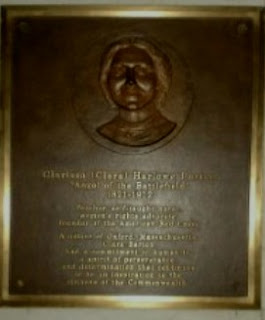
Boston, MA. - Clarissa "Clara" Harlowe Barton (1821-1912) was born in North Oxford, Massachusetts.  Barton was a hospital nurse during the American Civil War.  She was also a teacher, patent clerk, civil rights activist, and founder of the American Red Cross.  Barton became known as the "Angel of the Battlefield" for her work as a nurse during the Civil War. After the Civil War, Barton led the Office of Missing Soldiers in Washington, D.C.  Over the course of several years, this office help to locate, identify, and properly bury thousands of Union soldiers. On May 21, 1881, Barton founded the American Red Cross at her apartment in Washington, D.C.  In 1907, Barton published her autobiography called: The Story of My Childhood.  There is a plaque dedicated to Barton in Nurses Hall at the Massachusetts State House. Clara Barton plaque at the Massachusetts State House.

National Flood Insurance Program granted extension by U.S. Congress

According to the National Association of Insurance Commissioners floods are the most destructive natural disasters in the United States.   The National Flood Insurance Program (NFIP) was established in 1968 to help property owners with insurance coverage for the high cost of flood repairs for homes and other buildings.   “Flooding is the most common and costly natural disaster in the United States,” says Elizabeth Mendenhall – president of the National Association of Realtors.   The NFIP is administered by the Federal Emergency Management Agency.   NFIP has been in debt since Hurricane Katrina flooded New Orleans in 2005.   Over 1,000 disputed claims are still on file since Hurricane Sandy flooded the New Jersey shore in October 2012.   In October 2017, NFIP reached its borrowing capacity of $30 billion in order to keep paying current claims to flood insurance policy holders. “Put plainly, the N.F.I.P. is not designed to handle catastrophic losse...

Historical Profile: Dmitri Mendeleev

Dmitri Ivanovich Mendeleev (1834 – 1907) was a Russian chemist.   Mendeleev is credited with formulating the Periodic Law and he also established a version of the periodic table of elements.   Mendeleev also helped create the first oil refinery in Russia.   Mendeleev claimed to have seen his “Periodic System” in a dream: “I saw in a dream a table where all elements fell into place as required.   Awakening, I immediately wrote it down on a piece of paper, only in one place did a correction later seem necessary.”   In 1869, Mendeleev became one of the founders of the Russian Chemical Society.

Historical Profile: Irving Morrow

Irving F. Morrow (1884 – 1952) was an American architect who was best known for designing the Golden Gate Bridge in San Francisco, California.  In 1906, Morrow graduated from the architecture program at the University of California at Berkeley.  In addition to designing the Golden Gate Bridge, Morrow designed banks, hotels, schools, and theaters. In 1930, engineer Joseph Strauss hired Morrow to design the Golden Gate Bridge.  In 1919, prior to beginning work on the bridge, Morrow wrote about the potential for building a bridge in San Francisco: "The narrow strait is caressed by breezes from the blue bay throughout the long golden afternoon, but perhaps it is loveliest at the cool end of the day when, for a few breathless moments, faint afterglows transfigure the gray line of the hills."   At the time of its opening on May 27, 1937, the Golden Gate Bridge was the longest and tallest suspension in the world, spanning 4,200 feet.

FSMA renews commitment to protect nation's food supply

On January 4, 2011, President Barack Obama signed the Food and Drug Administration Food Safety Modernization Act (FSMA).   This legislative act was designed to better protect the nation’s food supply.   FSMA gives the FDA improved enforcement capabilities in preventing foodborne diseases.   One of the goals of the FSMA is to build a revised system for food safety.  It will create a food tracking system to identify the source of foodborne outbreaks. The U.S. Centers for Disease Control and Prevention estimates that about 48 million Americans become ill, 128,000 are hospitalized, and 3,000 die each year from foodborne diseases.   Another component of the FSMA is that it will provide the FDA with greater oversight of food products entering the United States.   About 15% of the U.S. food supply is imported; including 50% of fresh fruits, 20% of fresh vegetables, and 80% of seafood. The FSMA is considered to be the most significant revision in U.S. go...