Posts

Showing posts with the label History/biography

Historical Profile: Charles Brigham

Charles Brigham (1841 – 1925) was an American architect who designed several buildings in New England.   Brigham also served as a sergeant in the Union Army during the American Civil War.   Along with fellow American architect John Hubbard Sturgis, Brigham co-designed the original Museum of Fine Arts in Boston, Massachusetts.   Brigham’s other notable architectural designs include: the 1898 annex to the Massachusetts State House in Boston; the 1906 The First Church of Christ, Scientist in Boston; and numerous residential buildings.   Brigham also designed the Watertown, Massachusetts town seal.
Historical Profile: Fred T. Korematsu

Fred Toyosaburo Korematsu (January 30, 1919 – March 30, 2005) was a Japanese American civil rights leader.   Korematsu was convicted of evading internment during World War II when Japanese Americans were forced into internment camps.   Korematsu is known for petitioning against his internment.   In Korematsu v. United States the U.S. Supreme Court upheld the legality of the government’s order to bring Korematsu and other Japanese Americans to internment camps.   Executive Order 9066 signed by President Franklin D. Roosevelt authorized the government to take people of Japanese ancestry living on the West Coast from their homes and place them into internment camps.   Korematsu challenged this order and eventually his case was brought before the Supreme Court.   Years after the conclusion of World War II, the U.S. government acknowledged the injustice of interning Japanese Americans. In 1976, President Gerald Ford signed a proclamation officially term...

Historical Profile: Benjamin Banneker

Benjamin Banneker (November 9, 1731 – October 9, 1806) was born in Baltimore County, Maryland.   Banneker’s mother was a free black and his father was a freed slave from Guinea.   Although Banneker had little formal education he became well-known for his knowledge of astronomy and his political correspondence with Thomas Jefferson. Banneker’s greatest accomplishment was being a member of the team that surveyed the original borders of Washington, D.C.   This team was led by Major Andrew Ellicott.   Banneker’s astronomical knowledge helped him to write a series of almanacs.   Banneker’s almanacs were printed in Baltimore; Philadelphia; Wilmington, Delaware; and Richmond, Virginia. On August 19, 1791, Banneker wrote a letter to Thomas Jefferson.   In the letter, Banneker advocated for the abolishment of slavery in the American colonies.   Banneker wrote: “Sir, how pitiable is it to reflect, that although you were so fully convinced of the benevol...

Historical Profile: Daniel Chester French

Image
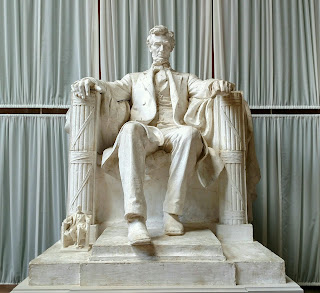
Stockbridge, MA. - Daniel Chester French (1850 – 1931) was one of the most prolific American sculptors during the late 19 th and early 20 th centuries.   In 1893, French became a founding member of the National Sculpture Society.   French was also a founding member of the United States Commission of Fine Arts.   In 1940, French was selected to be honored on a stamp for the U.S. Postal Service “Famous Americans” series.   His works of art are on display throughout the United States: most notably – the Abraham Lincoln statue (1920) at the Lincoln Memorial; the John Harvard statue at Harvard University; bronze doors at the Boston Public Library; the General Joseph Hooker statue at the Massachusetts State House; the Dupont Circle fountain in Washington, D.C.; the Minute Man statue (1875) in Concord, Massachusetts; and the Wisconsin statue (1920) on the top of the Wisconsin State Capitol Building. In 1931, French died at his summer home – Chesterwood in Sto...

Historical Profile: John A. Roebling

John Augustus Roebling (1806 – 1869) was a farmer and engineer best known for his designs of wire rope suspension bridges.   Roebling was born in the Kingdom of Prussia and eventually immigrated to the United States in 1831 with his brother Carl.   Roebling’s early engineering work focused on improving river navigation and canal building.   In 1976, Roebling’s home was placed on the National Register of Historic Places. Roebling’s most notable bridge designs include: 1. 1854 – Niagara Falls Suspension Bridge: 821 feet 2. 1866 – John A. Roebling Suspension Bridge (Cincinnati, Ohio to Covington, Kentucky): 1,057 feet 3. 1883 – Brooklyn Bridge: 1,595 feet

Historical Profile: Donald B. MacMillan

Donald Baxter MacMillan (1874 – 1970) was born in Provincetown, Massachusetts.   In 1898, MacMillan graduated from Bowdoin College.   During World War I and World War II he served in the United States Navy.   MacMillan is best known for his numerous expeditions to the North Pole.   He made over 30 expeditions to the Arctic during his 46-year career as an explorer, lecturer, researcher, and sailor. For more information about Donald B. MacMillan visit the Peary-MacMillan Arctic Museum & Arctic Studies Center at Bowdoin College: https://www.bowdoin.edu/arctic-museum/biographies/macmillan.shtml

Hear Us - Honoring the Contributions of Women to Public Life in Massachusetts

Image
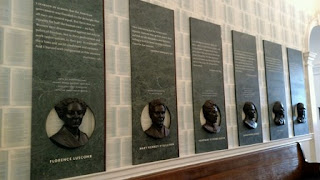
B oston, MA. – Hear Us is a permanent exhibit displayed inside the Massachusetts State House next to Doric Hall.   The exhibit, created by artists Sheila Levrant de Bretteville and Susan Sellers was completed in October 1999.   The exhibit pays tribute to the contributions of six women to public life in Massachusetts.   The honorees are: Dorothea Dix, Lucy Stone, Sarah Parker Remond, Josephine St. Pierre Ruffin, Mary Kenney O’Sullivan, and Florence Luscomb. The exhibit features a marble panel for each individual.   Each panel has a bronze bust of the honoree and two quotations from their speeches or writings.   The exhibit is the main component of the State House Women’s Leadership Project which was initiated by the Massachusetts State Senate in 1995.   The artwork for the exhibit was commissioned by the Massachusetts Foundation for the Humanities. Dorothea Dix (1802 – 1887): Her report, Memorial to the Legislature of Massachu...

Book Review - Genius of Place: The Life of Frederick Law Olmsted

Published in 2011, Genius of Place: The Life of Frederick Law Olmsted by Justin Martin chronicles the life of the one of the early American landscape architects.   In over 400 pages of text, Martin eloquently describes the amazingly brilliant, challenging, and sorrowful life of Olmsted.   Born on April 26, 1822 in Hartford, Connecticut, Olmsted was an avid reader.   He also had a dedicated work ethic and a talented speaker.   Before finding his true life passion as a landscape architect and conservationist, Olmsted worked as a surveyor, clerk, sailor, and farmer.   Olmsted also worked as a journalist.   He traveled to the American south and wrote articles about slavery and southern life for The New York Daily Times.   Olmsted also wrote books as well: Walks and Talks of an American Farmer in England and A Journey in the Seaboard Slave States.   “Olmsted was quick to concede that slavery was wrong,” Martin writes on page 76.   After...

Historical Profile: Reginald F. Lewis

Image
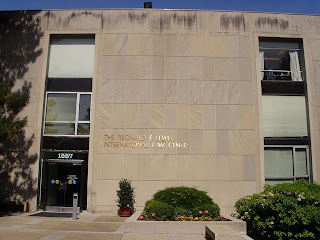
The Reginald F. Lewis International Law Center in Cambridge. Cambridge, MA. - H arvard University’s School of Law is the oldest law school in the United States.  Founded in 1817, Harvard Law School has trained recognizable leaders in fields such as business, law, politics, and social justice. President Barack Obama and several current justices on the U.S. Supreme Court are some of Harvard Law’s most prominent graduates. Another prominent graduate of the law school was Reginald F. Lewis.  The entrepreneur, businessman, and lawyer, lived by these words that he often quoted to audiences that he spoke too: "Keep going, no matter what." Lewis was born on December 7, 1942 in Baltimore, Maryland.  At an early age, Lewis developed a strong work ethic.  When he was ten years old he began delivering a newspaper in his neighborhood.  Lewis attended Virginia State University where he studied economics and political science.  Lewis also played on the footb...