Posts

Maldives elects new president

I n November 2013, the Maldives elected Yaamin Abdul Gayoom as its new president.   Gayoom is the brother of former Maldives president Maumoon Abdul Gayoom, who was president of the island nation for 30 years.   Yaamin Abdul Gayoom received 51.4 percent of the total vote defeating Mohamed Nasheed – the first democratically elected leader in the nation’s history.   With a population of nearly 400,000 people, the Maldives is the smallest country in Asia in terms of population and land area.   The island is composed of over 1,200 islands located in the Indian Ocean.   Most of the islands are uninhabited.   In 2004, several islands were badly damaged from a devastating tsunami.   The Maldives economy depends on fisheries and tourism.   Moving forward, two of the greatest challenges for the Maldives are rising sea levels and the potential of the government falling back into authoritarian rule. Facts about the Maldives: Capital: Male Major La...
Georgia Tech Researchers Announce New Tongue-Controlled Mobile Device

I n recognition of the International Day of Persons with Disabilities, United Nations Secretary-General Ban Ki-moon delivered a statement about working towards a more inclusive society.   On December 3, 2013, Ki-moon announced the new Accessibility Centre at UN Headquarters in New York.   According to Ki-moon there are currently more than one billion people living with disabilities worldwide. Researchers from Georgia Tech have developed a new wireless device that gives people who use motorized wheelchairs more independence.   The new device known as the Tongue Drive System is considered to be more efficient than the “sip-and-puff” wheelchair model.   The tongue-directed wheelchair uses a headset that translates the movements from a magnet that is embedded in a user’s tongue.   The magnet sends information to a program on a cell phone or computer which operates the movement of the wheelchair. By moving their tongues to the left or right, paralyzed patients...

Scientists Use Big Data to Understand Earth's Marine Ecosystems

A lthough the Earth’s oceans cover 71% of the planet’s surface, 95% of the underwater world remains unknown according to the National Oceanic and Atmospheric Administration (NOAA). The Earth’s oceans are an integral component for the planet’s climate, food supply, marine ecosystems, and weather. Scientists are now using big data to better understand the world’s oceans and marine ecosystems. Forbes.com contributor Lisa Wirthman writes about emerging oceanographic research in a recent article titled: “A Wired Ocean? How Big Data Is Saving Marine Predators.” In the article, Wirthman interviewed Stanford University marine biologist Barbara Block. There are several reasons for having a better understanding of the world’s oceans. Our ability to breathe oxygen is derived from the ocean — which shields CO2 from the atmosphere, Block explains. “What will help us better understand the planet’s condition is to better understand what’s underneath two-thirds of it, which is covered by wate...

New Technologies Focus on Reducing Food Waste

F ood waste is a significant international problem.  According to a 2013 United Nations report, approximately 1.3 billion tons of food is wasted annually.  The report,  Food Wastage Footprint: Impacts on Natural Resources  was the first research study to examine the impact of global food wastage from an environmental perspective.  The report also revealed that 28% of the world’s agricultural area or 1.4 billion hectares of land is used annually to produce food that is lost or wasted.  Worldwide food wastage costs an estimated $750 billion annually to food producers.  Wasting food also wastes the oil and water used to produce it.  Food that rots in landfills creates greenhouse gas emissions.  “All of us – farmers and fishers; food processors and supermarkets; local and national government; individual consumers – must make changes at every link of the human food chain to prevent food wastage from happening in the first place, and re-use ...

College campuses adapt to changing wireless network environment

I nformation-technology departments at college campuses nationwide have struggled to maintain and upgrade their wireless-network capacities.  With the substantial increase of wireless device ownership particularly for traditional college-age students, chief information officers at colleges and universities have grappled with how to increase wireless capacity. Bruce Maas, the CIO at the University of Wisconsin at Madison, estimates there are 100,000 mobile devices being carried by students at the university. Bring-your-own-device (BYOD) has created a unique environment at institutions of higher education.  At a number of college campuses, student and faculty usage of personal, internet-capable wireless devices has strained campus networks.  Network capacity is even more strained in large lecture halls and athletic venues.  “An increase in the number of devices is only part of the problem.  As the devices get more advanced, they eat up more bandwidth.  ...

Costly legacy of Vietnam War continues 40 years later

A ugust 15, 2013, marked the 40 th anniversary of the final bombing mission that the United States conducted during the Vietnam War.   Although the Vietnam War officially concluded on April 30, 1975, the legacy of the bitter conflict continues to the present-day.   On April 30, 1975 the North Vietnamese Army (NVA) seized control of Saigon, the South Vietnamese capital.   This event brought a thirty-year struggle to unite the country to a conclusion.   American military/political involvement in the war lasted from 1954 – 1975.   At the time, the Vietnam War was the longest conflict in American history.   It cost the U.S. $150 billion to fight the war.   Also known as the Second Indochina War, the conflict resulted in the deaths of about 1 million North Vietnamese/NLF troops and ¼ of a million South Vietnamese troops.   Over 58,000 U.S. service members died in the conflict.   The Vietnam War presented several unique occurrences in the hi...

Historical Profile: Rose Fitzgerald Kennedy

Image
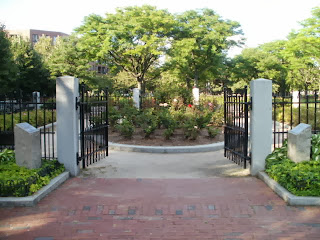
BOSTON – The Rose Fitzgerald Kennedy Garden is located in the North End section of Boston.   The garden is situated in between Christopher Columbus Park and the Rose F. Kennedy Greenway.   The garden is named after Rose Kennedy who was the mother of nine children, including Robert Kennedy – a U.S. Senator and John F. Kennedy – the 35 th President of the United States.   The garden was dedicated on July 20, 1987.   On July 22, 1890 Rose Kennedy was born in Boston.   Rose Kennedy was the daughter of John “Honey Fitz” Fitzgerald, who served as mayor of Boston from 1906-1907 and again from 1910-1913.   In 1914, Rose married Joseph P. Kennedy, who served as U.S. Ambassador to Great Britain.   Three of their children died in service to their country. There are two plaques located at the entrance of the Kennedy Garden.   In addition to the garden, there is a water fountain located next to the garden with a quote from Rose Kennedy inscribed on t...